
Dear friends,
We hope this newsletter finds you well wherever you may be, as academic terms begin to wrap up and the weather changes. As usual, following a public meeting, the newsletter consists mainly of the minutes, but we do want to inform you of an upcoming event on Friday November 28th from 2 to 4pm (UTC+1) at the University of Western Brittany in Brest, France. Two of our members will be presenting in French on the topic of the appropriation of Celtic material by far-right ideological actors, with a presentation of Carantes itself as a network of activists and scholars. The talk is hybrid and if you would like the Zoom link, please email us.
If you are in the area we strongly recommend in-person attendance, but in the spirit of making scholarship accessible we are delighted that there is a hybrid option too!
And now onto the minutes from our lovely meeting on November 18th!
We heard two fantastic talks by Dr. Rachel Moss and Dr. Siobhán Hyland, from the University of Northampton. They have collaborated multiple times, including on two projects: one examining published materials from the 1960s and 1980s containing far-right propaganda, and the second tracking a Twitter account that promotes ‘chivalric ideals’ as a gateway to radicalization into extremist right-wing groups.
This second project took up the bulk of the presentation. Its findings will be published next year, so we encourage you to keep an eye out for it! Broadly, Dr. Moss’s talk, titled “Historical Nostalgia, Medieval Chivalry and Masculine Identity Formation in Far-Right Online Spaces”, used material gathered from a specific Twitter account to examine the mechanisms by which young men and boys are radicalized into the far right through the construction of homosocial bonds, with a particular focus on the role nostalgia plays in this process.
Dr. Hyland’s talk followed, titled “Medieval Fascism or Fascist Medievalism?”. She spoke further about the importance of collaboration across fields and the logistics of working together. The Searchlight archive, “a major collection of material documenting the activities of British and international fascist and racist organisations,” was also discussed in more detail.
Overall both scholars insisted on the value of collaborative projects such as these; in the spirit of collaboration we also recommend joining MATER, or Medievalists Against the Extreme Right, a new research seminar group founded by Dr. Moss.
The Q&A that followed was extremely interesting. First, someone asked about the differences between the materials in Searchlight archive from the ’60s to the ’80s and today’s online extremists. Our speakers highlighted the role that the internet plays in precipitating violent rhetoric, which is less overt in the earlier documents.
Of course we also discussed paganism and Ireland in these contexts, whether these subjects occurred at all in the material they had reviewed and how. This is ground that remains to be covered in more detail but the archive is certainly rife with relevant material. In connexion to this, we also discussed the role of Evangelical Christianity in the rise of fascism in the USA, and whether there is a similar relationship in Britain. The internet muddies borders a great deal, making this a difficult and important topic. Notably, Celticism and religious extremism may be more connected than we had realized. Mel Gibson, whose middle name we learned is Collumcille, appeared to crystallize this intersection with his filmography that is both religious (The Passion of Christ) and has come under fire for anti-English sentiment (The Patriot), while also constructing a very specific, ahistoric and popular image of Scotland (Braveheart). Together with his history of antisemitic remarks, he seems to capture a particular profile within American politics today. To be perfectly honest, we lost our minds a little bit towards the end of the meeting reading about Gibson.
We also discussed the relationship between authenticity and nostalgia in the process of appropriating material, and how these spaces discuss femininity, and finally the identity search that modern representations of chivalry appear to foster. Ultimately, the main mechanism of radicalization is to isolate vulnerable individuals by giving them the feeling that they are part of select communities.
Finally, we talked about the availability of documents, editions and translations, and how this may have impacted various mainstream ideas about the Middle Ages or Celtic cultures. We also confronted the difficult reality that many of these radicalizing accounts (like the chivalry one that Dr. Moss had focused on in her talk) do, in fact, have decent understandings of the Middle Ages; part of the issue is that bad actors use their knowledge of these topics in a manipulative way.
It was a stimulating, dynamic discussion – as always, the public meetings leave us feeling energized and hopeful.
That is all for us now at Carantes. We will be taking the month December off, and thus wish you now a joyful, warm end of the year. Look for us in January 2026 for new recommendations, meetings, events and opportunities to keep building this community! And if you miss us too much, feel free to join the discord by emailing us for an invitation link.
In the meantime, be well and safe,
and thanks for doing this work with us.
Your friends at

Image credits:
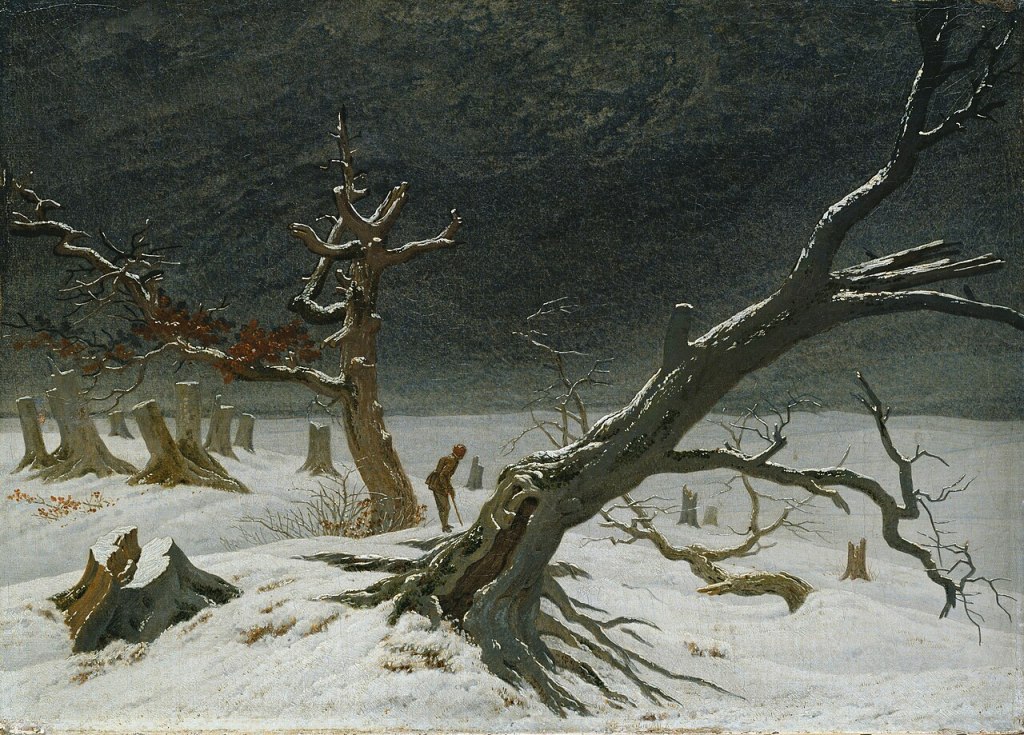
– featured image: Winter Landscape by Caspar David Friedrich, 1811 at Staatliches Museum Schwerin
– Logo by ForFeda
 CARANTES
Leave a comment