
Dear friends,
Happy new year! We hope you all have been able to spend time with loved ones over the holiday, resting in the fallow days that closed out 2025, and are returning energized to your various responsibilities, plans and pleasant routines. It has barely been three weeks of 2026, yet it already feels like a whole year’s worth of awful things have happened. As we compose this newsletter, we have to actively fight the sense that we need to tackle everything completely, thoughtfully. The truth is, there is too much for any one person, or in our case at the Steering Committee, even for a small group to comprehend, let alone process well enough to express: the shootings of Keith Porter, Renee Good and Alex Pretti, the ever-increasing reports that the immigration detention centers of the Trump regime are little more than death camps, the conflict in Sudan, the continuing catastrophic overtake of the Gaza strip, the apalling state violence against the people of Iran, whatever the hell Groenland is having to put up with… Even composing this list we have surely missed items that merit our attention, our compassion, our action. It is heartbreaking to face the reality that we cannot deal with everything, when everything feels so urgent.
We try to remember, as we continue the slow work we have chosen to commit to through this platform, that we are only small, and that the barrage of intensely terrible news, particularly that generated by the current administration of the United States, is intentionally designed to overwhelm us, like a big platter of evil spaghetti. The president and his team have adopted the strategy of throwing the evil spaghetti at the wall, and much of it does not stick, but it doesn’t matter: the purpose is to make us feel like there is too much for anyone to ever clean up. In the face of this, it is essential not to give up. But how?
Managing news consumption is an important first step. To that end we must accept that we cannot pay attention to everything and still hope to accomplish what is in our power to accomplish. We cannot allow ourselves to shut everything out, because that is the purpose of this flood. In our own little circles, we can try to pick one thing and stick with it, to educate ourselves so that we can educate others, who have picked a different thing, and to take the little steps immediately before us to make things better. This is solidarity in activism.
Secondly, we must face another truth: no one is a perfect activist. This can help us find compassion for people who are on the same side as us generally, but differ on certain points, and through compassion, build dialog. Imperfect allies are better than none, and those of us with privilege can use it to build bridges where we cannot expect the most oppressed among us to do so. It also helps move out of inaction, if we know we are contributing to a world where imperfection is met with kindness. Waiting for the perfect action to present itself is useless; the best action is the one you can do today, no matter how small, no matter how imperfect. Resistance is a muscle. Build it carefully.
Logistics
In the spirit of finding the best scale at which to operate, we want to let you know that we are changing our newsletter schedule a little bit this year. In order to be able to host more meetings, we will be sending out newsletters only in the months before and after our usual quarterly meetings. We will be recommending readings before the meetings, and sending out meeting minutes afterwards. In the downtime between newsletters, we will be working on hosting more talks, and holding more workshops. We hope this slight change in the format will give everyone more of a chance to attend, and continue to build community together.
Imbolc Public Meeting
Speaking of which, our Imbolc 2026 public meeting will happen on Friday February 6th from 2pm to 4pm UTC+0. Remember to email us to RSVP! This year we want to focus particularly on digital spaces and the particular modes of radicalization that can occur there. We would like to thoroughly understand the dynamics at play so that we can begin to produce tools for educators to help others navigate the complex world of pipelines, echo chambers, algorithms, AI, how it all connects to Celtic studies and provides the infrastructure that has led to this historical moment. To that end, we will begin on February 6th by discussing Kaluža, J. (2022). Habitual Generation of Filter Bubbles: Why is Algorithmic Personalisation Problematic for the Democratic Public Sphere? Javnost – The Public, 29(3), 267–283. As always, please email us if you cannot access this piece.
Before getting into the article proper, it’s important to note that it was published in 2022, before the rise of generative AI and Elon Musk’s twitter take-over. A lot has happened in the online world since then, and the timing of this article is interesting in allowing us to reflect on what has changed, and especially what trends have become more obvious when it comes to the use of algorithms. In this piece, Kaluža focuses on the notion of filter bubbles, how they come to be, and how problematic they can be for the functionning of the public sphere. In particular, the author focuses on the concept of habit as a key element in the formation of these bubbles, and on how the human element works in tandem with the technology in this phenomenon of radicalisation. Kaluža points out how prior research has neglected this angle, and had therefore minimised the reality and danger of filter bubbles on public discourse. The relationship between habit formation and addiction underlined in the article is one that seemed particularly relevant to what can be seen in online spaces today. Once again, the situation has greatly evolved in the past four years, and this article might feel outdated in places, but it is a good place to start and reflect on the mechanisms at play behind online radicalisation and the role algorithms play in it, as well as its impact on the public sphere and the health of democracies.
As part of the meeting, we are also going to have a brief discussion of some ‘Red Flags’ in regards to the medieval and ancient Celts, topics that are misrepresented or used for malign purposes. For example, outside of a Celtic context, the Roncevaux Pass in the Song of Roland is often used by European white supremacists and depicted as a defense of Europe against foreign invaders. The collection of medievalists organized by Dr Rachel Moss, who spoke to us at Samhain, is considering assembling a brief primer for medievalists of different backgrounds to help identify key areas of concern when teaching, which this would hopefully help support.
That is all for now from us at the CARANTES steering committee. Please feel free to contact us if you have any reactions, thoughts or concerns, or if you would rather not get any more emails.
Until next time, keep well and safe, and thanks for doing this work with us.Your friends at

Image credits:
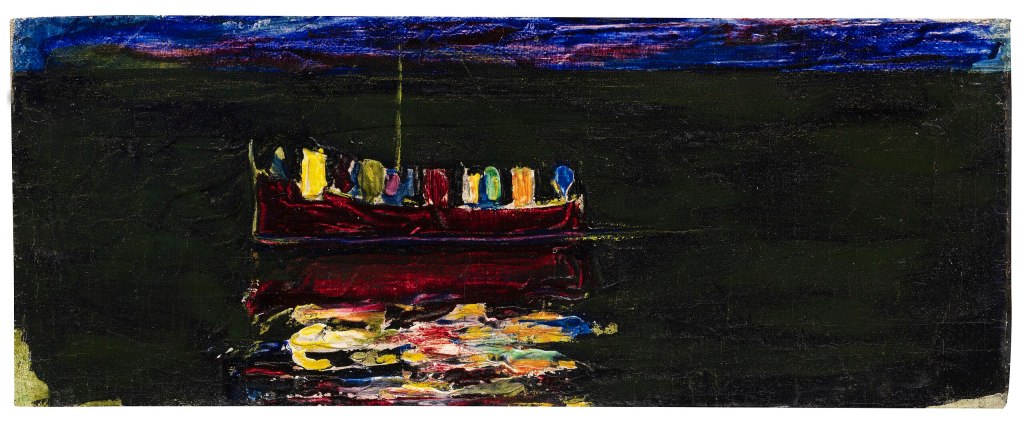
Boat with lanterns, Wassily Kandinsky, public domain.
Logo by ForFeda
 CARANTES
Leave a comment