
Dear friends,
With the arrival of green spring in the northern hemisphere, we hope you all have found time to enjoy nature’s awakening or, if you’re in the southern hemisphere, the distinct beauty of its seasonal fading.
We’ll keep this newsletter a little shorter than recent ones, and are delighted to invite you to our Beltane Public Meeting, which will take place on May 15th from 3 to 5pm UTC+1. We’re aware this is a little later than the usual Beltane dates, but with the end of the academic term that’s the first date we could make work! Alas, the modern world has little care for our pagan calendars.
We’ll be discussing this article: Holzberg, Billy. “Fear: Great Replacement Ideologies as Paranoid Border Politics.” In Affective Bordering: Race, Deservingness and the Emotional Politics of Migration Control. Manchester University Press, 2024.
This piece brings together two elements of concern to us. It retains a background awareness of digital radicalization, as much of the “Great Replacement” conspiracy theory proliferates online, particularly in its most violent manifestations, while speaking directly to decisions and actions by policy-makers. Though focused on Germany, Holzberg’s examination of “the construction of certain objects and bodies as inherently fearful” (p. 118) is applicable internationally. The most dire examples of racism and xenophobia against migrants (warning: the article details abuse at an immigration centre) are currently coming from the United States, but there are few western countries who do not face similar issues as fear continues to dominate public discourse on international relationships.
Holzberg’s analysis of the role of fear as a motivator of policy rests on the idea that “racist paranoia is not the outcome of individual psychology but is produced by wider social forces and given shape through political ideologies and networks” (p. 124). Crucially, this results in a form of “affective bordering” that cannot be combatted by the now common refrain among left-wing politicians to “take people’s fear seriously.” Instead, Holzberg argues that “what is needed are more confrontational affective strategies in which racist fear-mongering and misinformation need to be confronted through a focus on the transnational histories and material structures that would actually help explain and tackle problems of inequality and exclusion today” (p. 130). To this end, he proposes a useful analysis of “White Innocence” (see pages 130 to 132) which is applicable to the Celtic context.
The article ends on a section titled “Fear as collective world-making” (see pages 134 to 136). By examining the legitimate fear experienced by immigrants living in places where border policies are increasingly violent, Holzberg shows that fear can also be a force around which to build “new communities of care and political action” (p. 134).
Broadly, the article asks whose fear is taken seriously, and whose fear is infantilized, and in doing so gestures to solidarity as a possible result of fear. And after all, for many of us who have led comparatively privileged lives, has fear not become a disconcerting companion? Whether because of the volatile decisions of the most powerful man in the world, seemingly made with no regard to anything but whim and self-preservation, or because of the increasing incidence of unseasonable weather patterns, many of us who have never had to deal with systems designed to make us feel this way before have begun to understand the weight of deeply existential fear as a daily thing. Holzberg does not make this point, but it is likely that the expansion of geopolitical instability to the countries largely responsible for it, and for a long time insulated from its effects, has given rise to the very fear used to fuel the results of the “Great Replacement” conspiracy theory. At the same time, this increasing instability has the power to give rise to the construction of new solidarity structures.
The article “Inside the Hidden Network of Resistance in Minneapolis” recounts the tireless work of communities in Minneapolis to protect their most vulnerable members, and quotes one organizer:
“No one is trying to be the savior of anybody,” Claire says. “We are each other’s neighbors and community. These are people who celebrate Thanksgiving and Christmas together, who live in each other’s homes and take care of each other’s children. The mentality is, ‘If they’re crying, I’m crying. If they’re rejoicing, I’m rejoicing. If they’re under threat, we’re all under threat, and if they’re taken, I’m going to be in deep grief.’ No one is doing some kind of good deed. They’re family.”
We highly recommend reading the whole piece to ground Bill Holzberg’s article in the lived experience of those affected by policy-makers and neighbors who have let themselves become consumed by the folly of the “Great Replacement” conspiracy theory.
If you’re not familiar with the “Great Replacement” conspiracy theory, we suggest this PolitiFact article to get the gist. Another suggested “reading” is this video essay by Contrapoints on Conspiracy Theory, which begins to untangle the web of ideas and feelings generally at work in the wider mechanism of conspiracy. We won’t take the time to examine either of these together, but they may help to give context and can absolutely be brought up during the discussion.
In the second half of the meeting, as suggested in our Imbolc Public Meeting, we will begin workshopping together a document to encourage institutions to remove themselves from platforms directly profiting from the same power structures responsible for the current rise of fascism.
If you’d like to attend this meeting, please RSVP by email. We look forward to seeing you there.
Until then, keep well and safe, and thanks for doing this work with us.
Your friends at

Image credits:
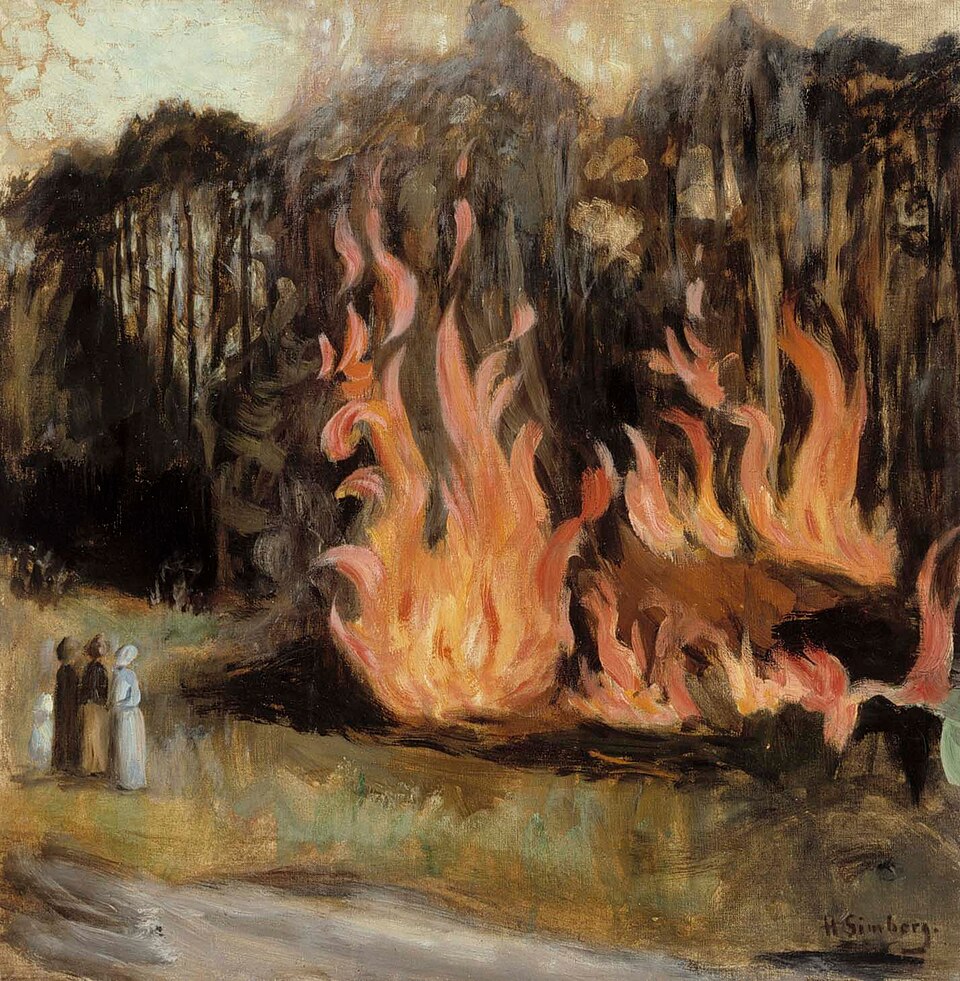
– “Bonfires” by Hugo Simberg (1873 – 1917), Finnish National Gallery, public domain.
– logo by Forfeda
 CARANTES
Leave a comment